
Visual priority
The heading, essential information, and primary action should be distinguishable without every element competing constantly for attention.
FARCOM / CLARITY BY DESIGN
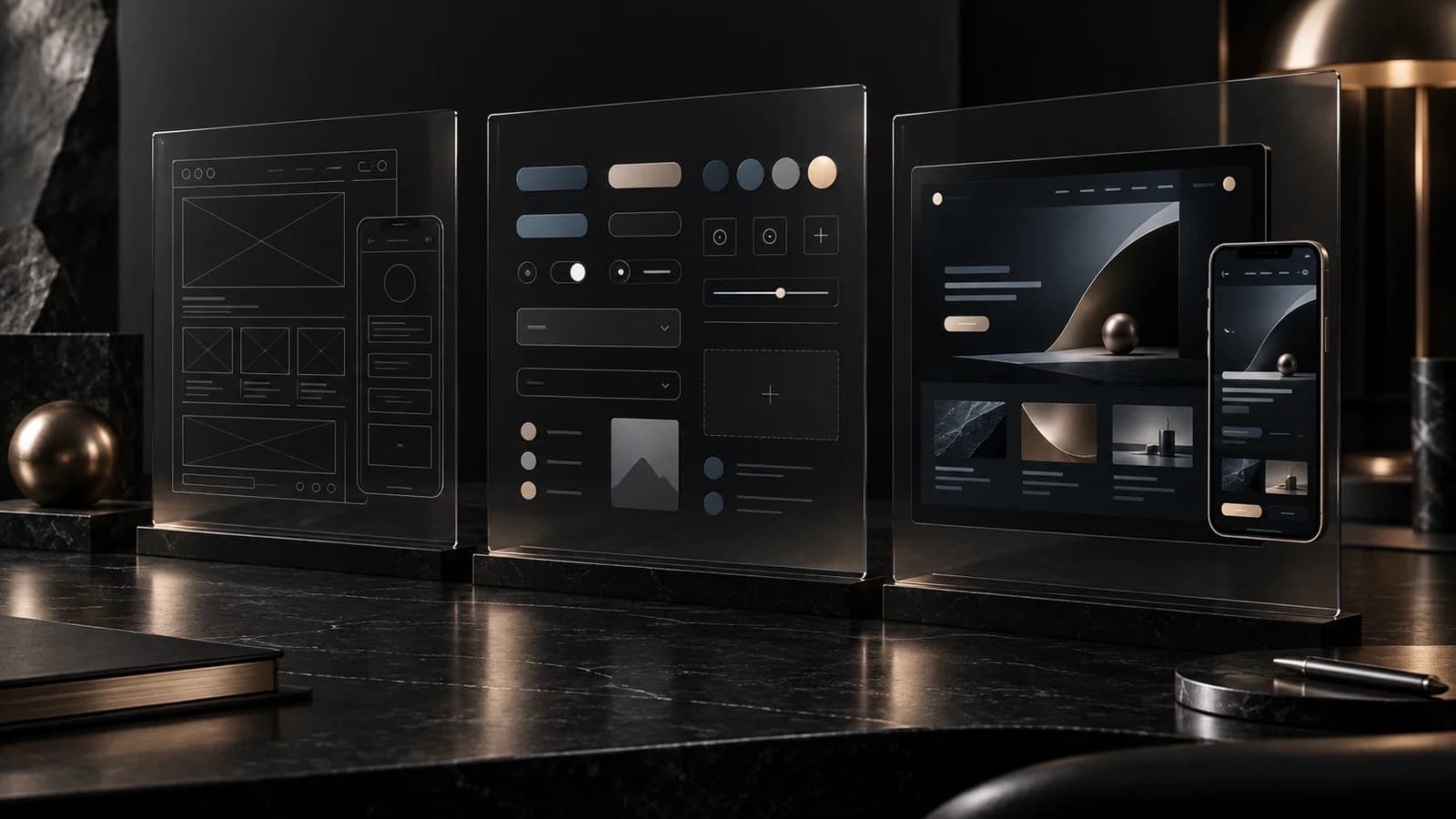
For your website, ecommerce experience, or software, we design a clear path to completing the task and an interface shaped around its users—from current-product review and wireframes to mobile UI, clickable prototypes, and developer handoff.
Design thinking,
alongside building experience.
01 / LESS FRICTION, MORE CLARITY
From understanding the problem to wireframes and a clickable prototype, explore three layers of a sample scenario. The right outcome is something tested with users, not merely something that looks polished in an image.
In this sample, the user wants to choose a meeting time. Showing every piece of information at once makes the primary decision harder. The design hypothesis is to move secondary details to the stage where they become useful.
Several competing decisions on one screen.
02 / EVERY DETAIL HAS A JOB
Every screen needs a clear purpose. We review interface, behavior, and content together so users find the answer they need at the moment of decision.
The heading, essential information, and primary action should be distinguishable without every element competing constantly for attention.
Interfaces are not designed only for complete data. Errors, empty results, waiting, and success also need a clear message and next step.
Readability, contrast, keyboard navigation, and presentation across screen sizes are part of the design review.
Color, type, imagery, and motion should serve the brand’s character and maintain a shared language across pages and devices.
03 / FROM INSIGHT TO HANDOFF
The engagement may cover one critical flow, a product redesign, or a complete design system. We define the outputs and level of detail for every stage before work begins.
Review business goals, users, and constraints. The research approach is selected around access to users, available data, and project scope.
Clarify information architecture, primary journeys, and exceptions before visual design—from starting a task to its result and error recovery.
Define color, type, spacing, and components in one visual language, including active, error, empty, and loading states.
Review an interactive prototype against defined scenarios. Document improvements and component behavior for continued development.
04 / DESIGN IN CONTEXT
In a catalog, imagery and product discovery lead. In an operational dashboard, information clarity and work status matter most. We shape structure, content density, and interface behavior around what the audience needs to do.
Explore all work →
05 / DESIGN AND ENGINEERING, TOGETHER
Technical constraints, real content, and component behavior are reviewed throughout design. Collaboration can continue with your development team, or FARCOM can provide both design and implementation.
Explore web application development ↗Review the product objective, users, priority flow, and constraints together.
Make critical decisions reviewable through wireframes and an interactive prototype.
Define components, states, responsive behavior, and interaction details for implementation.
When included in scope, compare the real implementation with the design and primary scenarios.
User experience concerns goals, structure, and the path to completing a task. User interface makes that logic usable through content, layout, and element behavior. The two should develop together with technical constraints and brand identity in view.
Begin with an observable problem: a lost journey, repeated errors, unclear content, or interface inconsistency. When available, behavioral data and user conversations help prioritize the work. A complete visual overhaul is not always the first answer.
The number and complexity of flows, user roles, research depth, existing-content readiness, and documentation needs all affect scope. Page count alone is not enough; error states, mobile behavior, and interactions also need definition.
Test scenarios, target users, and measures such as task completion, errors, and need for guidance are defined before evaluation. Without data and testing, we do not promise a conversion increase or shorter task time.
Describe the current product or initial idea, user groups, their most important task, and any time or technology constraints. Brand guidelines, sample content, and anonymized user feedback also help. When data or interviews are unavailable, we record the hypotheses and research limitations from the beginning.
Editable files, agreed flows, target-screen designs, reusable components, and error and loading states are defined in the delivery scope. Review rounds, font and image licences, and support for the development team should also be clear. Design handoff alone does not mean delivery of an implemented website or application.
BEFORE WE DESIGN
Clarify the path before we begin.
Prepare your project brief ↗Yes. The scope can cover research and experience architecture through prototyping and a design system, while FARCOM can also provide technical implementation.
Designers and engineers work together from the early stages, with technical constraints, real content, and interface states considered throughout design.
We analyze current behavior, friction points, and product constraints, then prioritize changes and implement them incrementally when appropriate.
The number of flows and roles, research depth, target screen sizes, interface states, and required documentation affect the estimate. Page count alone is not enough; each stage’s outputs and review rounds are also defined before work begins.
Editable files, components, prototypes, and specifications required for development are listed in the project agreement. Font, image, and other third-party asset licences are reviewed separately.
We can begin by reviewing the existing product, available data, and team knowledge, but assumptions do not replace observing users. Research limitations are recorded, with opportunities for later testing included in the ongoing plan.
LET’S MAKE THE NEXT STEP CLEAR
Tell us about the current product or the initial idea.
Together, we’ll define the right place to begin.