
01D2C
Direct-to-consumer store
A direct sales experience for brands that want identity, product, and customer relationships in one place.
FARCOM / DIGITAL COMMERCE
From the purchase experience to the systems behind every sale.
From finding a product and paying to fulfilment and delivery, every stage should be clear to customers and your team. FARCOM begins with your products, sales model, and existing systems.

FARCOM experience, behind your path to growth.
Design, engineering, and system integration—
shaped around your business model.
01 / FROM DISCOVERY TO DELIVERY
Four important decisions in one continuous experience. Scroll through the journey or try the demo store yourself.
01 / DISCOVER
Clear categories, useful search, and comparable information keep a growing catalog understandable.
Clear categories, useful search, and comparable information keep a growing catalog understandable.
Specifications, price, availability, and quantity belong together. Product detail design answers the buyer’s real questions.
An editable cart, transparent costs, and delivery choices. Payment follows the market, provider, and business rules.
Orders connect to inventory, fulfilment, delivery, and customer communication, with failure handling shaped around existing systems.
02 / YOUR BUSINESS, YOUR RULES
A consumer product, a B2B wholesale order, and a subscription do not follow the same logic. We begin with your sales model and operational needs.
A direct sales experience for brands that want identity, product, and customer relationships in one place.
Flexible architecture for large catalogs, advanced filters, and broad product variation.
A multi-vendor experience with distinct product, order, settlement, and management workflows.
Contract pricing, access levels, bulk orders, and organizational approval workflows.
Plan, renewal, and access management, with recurring payment subject to the selected payment provider.
Booking, access, licensing, or digital delivery with a purchase path shaped around the service.
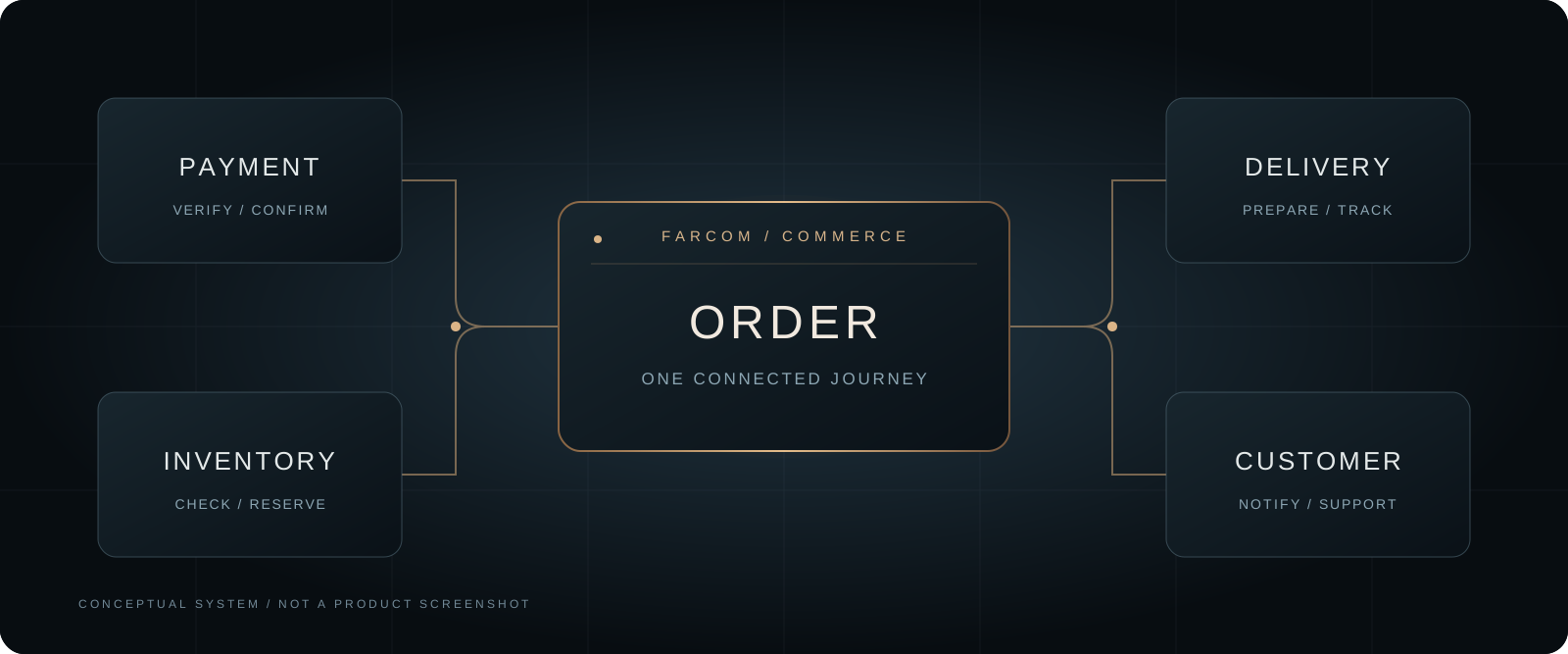 COMMERCE / CONNECTED BY DESIGN
03 / BEYOND THE STOREFRONT
Discounts, inventory, delivery cost, and customer level need to work together. We clarify the rules and system responsibilities before development, then build the interface and commerce logic around them.
Catalog, customers, and operational constraints
Maintainable interface, data, and integrations
Purchase journeys, failure handling, and security review
Current technology, selected around the project
 React
React Next.js
 TypeScript
 Node.js
 PostgreSQL
 Docker
 WordPress
 Python
04 / A COMPLETE COMMERCE FOUNDATION
Capabilities are selected around business priorities. The scope of every feature, integration, and maintenance service is defined before implementation.
From product attributes and variations to wholesale prices and customer groups, sales rules need a clear information model.
Products · Variations · PricingOrder status, return requests, and customer communication are designed as one manageable path.
Orders · Tracking · CRMAccess control, input validation, and sensitive journeys are reviewed during development and before launch.
Access · Data · ReviewProduct, content, and order management should be clear to your team, with roles aligned to responsibility.
Admin · Content · TeamCategory structure, product pages, URLs, and performance are considered together with an easy mobile purchase journey.
Structure · Speed · SearchConnections to inventory, accounting, and delivery services are defined around available APIs and system constraints.
Inventory · Accounting · APIs05 / KEEP WHAT YOU HAVE BUILT
Products, customers, order history, and valuable URLs are reviewed before moving. The goal is to preserve assets and reduce the risk of changing systems.
Prepare your ecommerce requirements ↗Inventory data, pages, and current integrations
Map fields and validate the transferred information
Redirects, test orders, and error review
06 / EXPLORE OUR WORK
Explore how Eron Home presents furniture and interiors and guides product selection. Other FARCOM projects also explain the business need and delivery scope, so you can review the example closest to your model.
Before choosing technology, clarify what you sell, how orders are prepared, and who keeps store information current. Those answers shape the design and the estimate.
Define comparable attributes, variations, price, and inventory for every product group. Clear photography, practical descriptions, delivery, and return terms support a confident decision. Wholesale sales may use quotations and approval instead of direct checkout.
WordPress and established commerce platforms may suit a conventional catalog and sales process. Plugin quality, licence cost, and maintainability matter. Complex pricing, permissions, or integrations may justify custom development; the stack should follow the requirement.
If inventory lives in warehouse or accounting software, define the source of truth and synchronization timing. Duplicate orders, failed payments, and delivery-service outages also need recovery paths. Documentation and test environments improve integration estimates.
Categories should help people choose and product pages should explain real specifications, use, and constraints. URLs, page titles, internal links, images, and mobile behavior are reviewed together. Existing valuable URLs need a planned migration.
Page templates, product entry, payment and delivery connections, migration, training, and acceptance criteria need an explicit scope. Hosting, licences, and third-party services should be separated from design and development costs.
Read the ecommerce requirements guide and explore the Eron Home project.
07 / BEFORE YOUR NEXT STEP
Clarify the path before we begin.
Prepare your project brief ↗Identify the product type, a few example products, the primary audience, delivery methods, and current software. If you already have a store, share its address and the problems your team experiences in sales or order management.
Outputs and acceptance criteria are agreed before implementation: pages and capabilities, management access, training, and required documentation. Test orders, payment status, delivery calculations, access control, and mobile display are reviewed.
We first assess the current data structure and export options, then define the migration map, backups, and validation process. The scope and timing depend on the existing platform.
Search foundations begin with categories and product architecture, then URLs, metadata, internal links, and mobile performance. Sustainable visibility also requires useful content and ongoing improvement after launch.
A proven platform may be the practical choice for conventional sales rules. Custom development becomes relevant when pricing, user roles, workflows, or integrations are more complex. We compare launch budget, maintenance cost, and actual requirements.
Integration depends on the version and documentation of the existing software. We clarify the source of price and inventory, where orders are recorded, and what happens if a connection fails.
Yes. Customer levels, contract prices, bulk ordering, credit limits, and approval stages can be included where the business process requires them.
Catalog size, pricing and delivery rules, custom design, integrations, and migration volume shape the estimate. We define the essential first release, timeline, cost, exclusions, and third-party expenses in the proposal.
The support period and scope are agreed for each project. Defect resolution, updates, performance review, and new development are distinct services, with clear ownership and request handling.
LET’S BUILD YOUR COMMERCE
Whether you are planning a new store or changing an existing system,
share your products, audience, and priorities with us.