
Customer portal
Service requests, documents, case status, and support communication in one personal, trackable space.
FARCOM / CONNECTED WORK
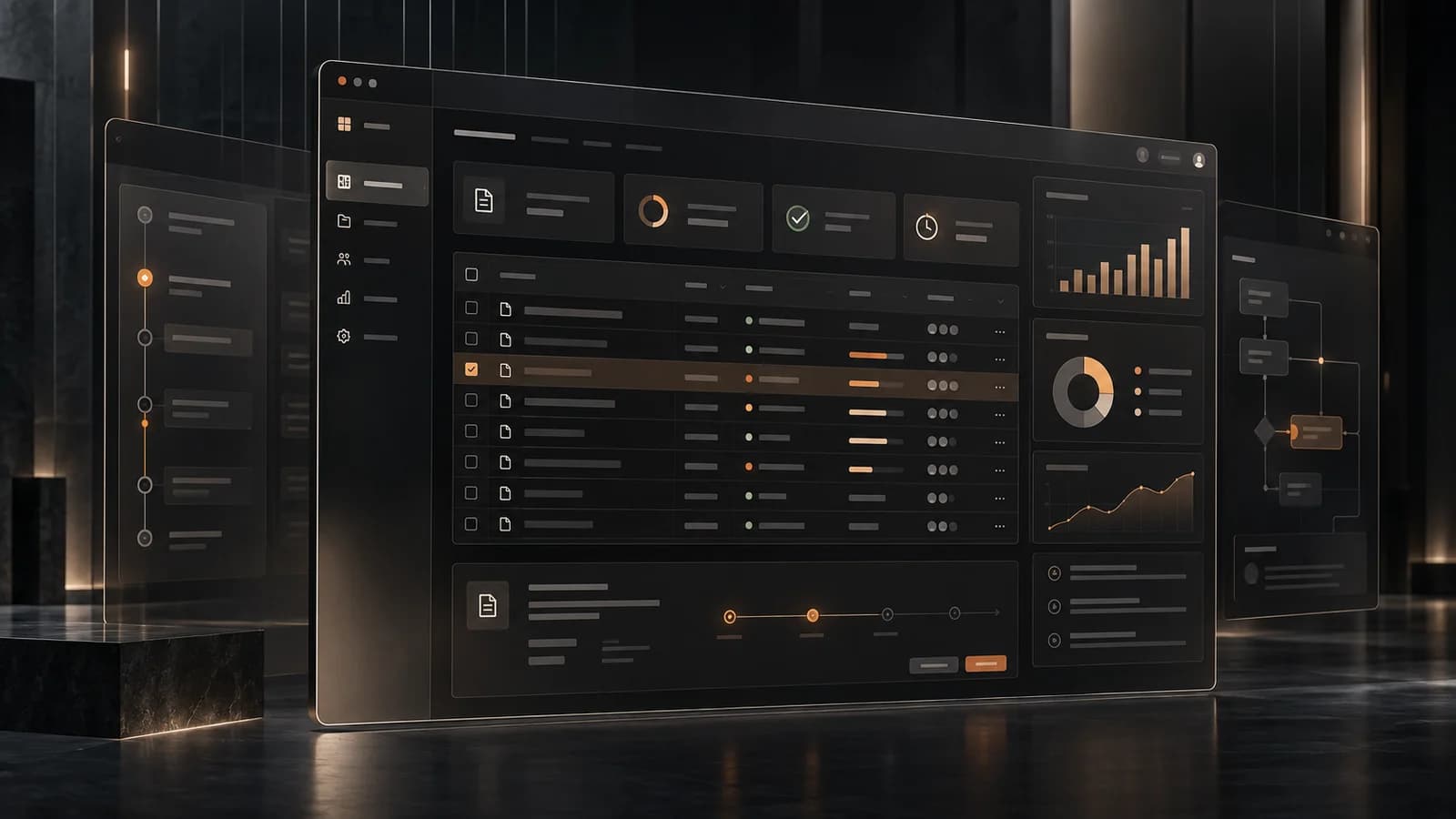
From customer dashboards to organizational portals, we build a dedicated environment connecting your users, information, and processes—so everyone knows what needs attention and what comes next.
Product decisions backed by
years of building.
01 / A PLACE FOR EVERY ROLE
We choose the portal model around its users and the work they need to complete. These experiences can stand alone or connect within one platform.
Service requests, documents, case status, and support communication in one personal, trackable space.
Access to private information, order or opportunity entry, and approval tracking according to each partnership level.
Team queues, approval workflows, ownership, and reporting for processes currently scattered across files and messages.
02 / ONE REQUEST · A CONNECTED JOURNEY
Follow a sample service request. Scroll or select a role to see the same request change from the customer’s view through to the operations team.
Scope, service location, and supporting documents have been submitted.
A service-specific form gathers the required information and documents in one place. The customer sees a tracking number and the next step instead of chasing scattered messages.
Role at this stage: CustomerThe request enters the correct team queue. Access, approvals, and returns for correction follow the organization’s real process instead of giving everyone the same permissions.
Role at this stage: SpecialistThe result, owner, and status history remain together. Reporting uses the same data, and integrations with other systems can be defined when an API is available.
Role at this stage: Operations lead03 / ENGINEERED FOR DAILY USE
Custom development for your business logic, with technology selected around product needs, team experience, and long-term maintainability.
Roles, permissions, and data ownership are defined before screens. Single sign-on can also be assessed when the need and infrastructure support it.
The happy path is not enough. Missing documents, rejection, returning to a previous stage, and reassignment all need defined behavior.
For every integration, we define the data source, authentication method, and failure behavior so an unavailable service never creates an ambiguous state.
Critical-flow testing, error monitoring, and backup planning are defined in the technical scope. Target capacity informs performance testing.
Current technology, selected around your project.
 React
React Next.js
 TypeScript
 Node.js
 PostgreSQL
 Docker
 WordPress
 Python
The final stack is selected around security, performance, integration, and maintainability.
04 / SMALL RELEASES · CLEAR OUTCOMES
Instead of beginning with a long feature list, we shape the first release around the work that creates the most value. Cost and timing become clear once that scope is defined.
Define the first release together ↗Identify roles, data, existing systems, and the points where work currently stops.
Review an interactive prototype with key users before committing to full development.
Implement the interface, logic, access, and integrations incrementally, testing the critical journeys.
Define deployment, training, documentation, support scope, and the direction of the next release.
EXPERIENCE / IN CONTEXT
Review our published projects to assess FARCOM’s approach to design and implementation. The portal on this page is a conceptual workflow demonstration, not a client project.
Explore FARCOM’s work ↗
When people need to perform tasks, submit data, or track a process, the need goes beyond a company website. A web application can provide those operations in the browser. Offline behavior, notifications, or device capabilities are assessed separately; a web app is not always a replacement for a native application.
Before migration, we review data structure and quality, ownership, and the available integration path. Data mapping, a trial migration, result validation, and a rollback plan should be part of the scope. Integration with existing software depends on its documentation and technical access.
The number of roles and workflows, permission complexity, integrations, data migration, and expected availability all affect scope. The first analysis output is a release with clear acceptance criteria, making the estimate and delivery plan reviewable.
Describe one example process from submission to completion: who creates the request, who approves it, and what exceptions occur? Approximate user counts, current systems, transferable data, and essential reports are also useful. There is no need to share confidential user data to begin.
The agreed workflow, roles and permissions, required panels, named integrations, and usage documentation should be recorded in the delivery scope. We define acceptance criteria for every journey—for example, a customer can see a request, an authorized owner can change its status, and the change is recorded in history.
If you need to present services and capabilities, explore corporate website design. To compare broader operational needs, see custom software development.
BEFORE WE BUILD
Clarify the path before we begin.
Prepare your project brief ↗A website primarily presents information and content. A web application is built for completing tasks, managing data, and running an interactive process.
When an API or another secure data-exchange path is available, integration with existing systems can be included in the project architecture.
Roles and permissions, authentication, event logging, and security controls are designed around the platform’s data and risk profile.
The web interface can be designed for mobile browsers. Needs such as offline operation, notifications, and device capabilities are assessed separately and may call for a PWA or native application.
Yes. The first release can focus on one workflow, essential roles, and priority integrations. Its outputs and acceptance criteria are defined before implementation, while later capabilities are estimated separately.
Hosting, error monitoring, backups, updates, and request handling need a defined scope. External-service costs and new capability development are separate from routine support; commitments and response times are documented in the service agreement.
LET’S CONNECT THE WORK
Tell us about the users, stages, and current systems.
Together, we’ll define the right product starting point.